...
THE CORE INTELLIGENCE LAYER

THIS IS THE SOFTWARE THAT MAKES
A VEHICLE DRIVE ITSELF.

The system calculates optimal paths in real time based on mission parameters, field boundaries, no-go zones, and live sensor data. When conditions change — a new obstacle, a shifted boundary, a machine ahead falling behind — the planner recalculates instantly. Paths can be defined through Mission Control, imported from GIS files, or recorded from a human-driven pass (breadcrumb mode).

Not every application requires full autonomy from day one. The software supports multiple operational modes that OEMs can deploy incrementally:

  • Autonomous Driving— Full mission execution from planned paths.
  • Leader-Follow — Formation driving where one or more vehicles follow a lead machine.
  • Breadcrumb Recording — An operator drives the path once; the machine repeats it autonomously.
  • Manual Override— Seamless transition to operator control via handheld controller.
  • Remote Monitoring— Supervisory oversight with intervention capability.

GPS signals are unreliable in orchards, forests, underground mines, and near tall structures. The navigation software fuses data from inertial measurement, wheel odometry, vision-based localization, and LiDAR feature detection to maintain accurate positioning when satellite signals are degraded or unavailable. This was proven at commercial scale in dense orchard environments — navigating under full tree canopy with no usable GPS signal.

Restrict autonomous operation to predefined areas and approved routes. Define no-go zones, no-spray zones, and operational boundaries. The vehicle cannot leave its geo-fence regardless of mission state — this is enforced at the software level with hardware watchdog backup.

PERCEPTION & COMPUTER VISION

The software that gives machines situational awareness.

Mach's perception software processes data from cameras, radar, and LiDAR to understand the vehicle's environment in real time. The algorithms are compute-platform agnostic — they run on Mach's own hardware but can also run on third-party compute architectures.

Obstacle Detection & Classification

Neural network-based detection that identifies and classifies objects in the vehicle's environment — people, vehicles, equipment, vegetation, terrain features. The system distinguishes between a person (immediate shutdown) and a bush (navigate around) in real time.

Custom Neural Networks

The perception architecture is open. OEMs can deploy Mach's pre-trained models or run their own custom neural networks on the same platform. An agricultural OEM can train crop-specific detection models while a defense contractor trains for threat identification. The software supports model deployment, versioning, and updates without hardware changes.

Sensor Fusion
Sensor Fusion

No single sensor handles every condition. The perception software fuses data from multiple sensor types — stereo cameras, LiDAR, and radar — into a unified world model. Each sensor compensates for the others' weaknesses. Cameras provide rich classification data. LiDAR provides precise geometry. Radar penetrates dust, debris, and obscurants that blind cameras and LiDAR. The fusion layer combines all inputs into a single reliable perception output regardless of environmental conditions.

Visual Navigation
Visual Navigation
  • 1) Row Following — Track crop rows, tree lines, or path boundaries using cameras alone

  • 2) Edge Following — Maintain consistent offset from field edges, berms, or structures

  • 3) Visual Odometry — Estimate vehicle motion from camera data when wheel encoders or GPS are unreliable

  • 4) Pattern Following — Follow visual patterns in the environment, such as cut/uncut lines in mowing or harvested/unharvested rows

Radar Signal Processing
  • 1) Through-Dust Detection — Identify obstacles through dust clouds, debris, jet wash, & heavy rain

  • 2) Depth Sensing — Measure soil depth or surface profiles with centimeter-level precision

  • 3) Surface Quality Mapping — Assess surface roughness for grading, seedbed preparation, or road maintenance quality verification

  • 4) Sub-Surface Detection — Identify organic matter and material composition below the visible surface
SAFETY SYSTEMS

Software that ensures the machine always reaches a safe state.

Safety isn't a feature — it's a system design principle built into every layer of the software stack. Mach implements three independent safety layers that operate simultaneously:

Sensor Fusion Obstacle Map

Aggregates detections from all perception sensors into a unified obstacle map. If an obstacle is detected in the planned path, the vehicle stops and waits. When the obstacle clears, the vehicle resumes automatically.

Virtual Bumper

Continuously projects the vehicle's trajectory forward and calculates time-to-collision. Automatically modulates speed — slowing progressively as proximity increases, stopping before contact. The vehicle remains in autonomous mode and resumes when clear.

Person Detection Shutdown

A dedicated safety layer specifically monitoring for human presence. If a person is detected within the safety zone, the vehicle stops, disengages implements, and requires manual operator acknowledgment before resuming. The vehicle does not auto-resume — a human must explicitly clear the condition. All three layers are independent. A failure in one does not affect the others. The entire safety stack is backed by a hardware watchdog that forces a safe stop if the software becomes unresponsive.

Functional Safety Framework

The software is engineered to ISO 25119 with systematic hazard analysis (HARA), fault tree analysis (FTA), and failure mode and effects analysis (FMEA). This isn't a prototype safety concept — it's a production safety framework validated across hundreds of deployed machines.

IMPLEMENT CONTROL

Software that does the actual work — not just driving.

Autonomy isn't just about getting from point A to point B. It's about doing productive work along the way. Mach's implement control software manages attached tools through standard industrial protocols (ISOBus, CAN J1939, and proprietary interfaces).

  • Section Control

    Automatically activate & deactivate spray nozzles, seeding units, or spreader sections based on coverage maps & prescription data

  • Rate Control

    Adjust application rates in real time based on prescriptions, sensor feedback, or variable-rate maps

  • Height Control

    Maintain optimal implement height using radar or vision feedback

  • PTO Management

    Engage and disengage power take-off based on mission state and geo-fence position

  • Quality-of-Work Sensing

    Monitor variables like coverage completeness, application accuracy, dust levels, and surface condition

MISSION CONTROL

the operator interface for planning, monitoring, and managing autonomous operations.

Mission Control is the software that puts an operator in command of one or many autonomous machines — without requiring specialized training or an engineering background.

Plan
Plan

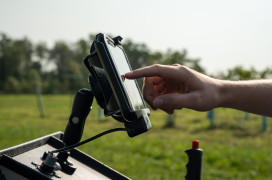
Define operational boundaries, create paths, set no-go zones, and configure mission parameters through a touch interface. Import existing field data from GIS files, define custom path patterns, or generate coverage paths automatically. Save and reuse mission plans across seasons, sites, and machines.

Monitor
Monitor

Real-time visibility into every machine on the network. Live position, speed, heading, implement status, sensor health, and coverage progress — all on a map overlay. Event notifications for any condition requiring operator attention.

Execute
Execute

Launch missions, coordinate multi-machine operations, and manage work in real time. The software handles sequencing — which machine goes where, when implements engage, how coverage overlaps are managed. Operators supervise and handle exceptions. They don't drive.

Override
Override

Instant intervention when conditions require human judgment. Physical joystick control via handheld controller. One-button E-Stop that halts every machine on the mesh network simultaneously. Seamless transfer between autonomous and manual operation without restarting the mission.

Multi-Machine Supervision

One operator supervising multiple machines. This is the core labor multiplication story. The software is designed around the premise that trained operators are scarce and getting scarcer — so the interface must let one person do what used to require a crew.Available on iOS, Android, and Windows. Customizable to OEM branding and machine-specific configurations.

FLEET PLATFORM (OPS CLOUD)

The backend software that keeps autonomous fleets running and improving.

Over-the-Air Updates

Deploy software updates to individual machines or entire fleets remotely. No site visits. No USB drives. Stage updates, roll out incrementally, roll back if needed. This applies to navigation software, perception models, implement configurations, and firmware.

Device Provisioning & Licensing

Secure onboarding for new machines with automated registration, certificate management, and capability licensing. Supports the full ownership lifecycle — manufacturer to dealer to end customer — with role-based access at every level.

Subscription Management

Enable capability-based subscriptions for advanced features — precision positioning, visual navigation modes, advanced perception models, fleet analytics. This is the recurring revenue model that turns a hardware sale into a long-term software relationship for OEMs.

Fleet Analytics & Diagnostics

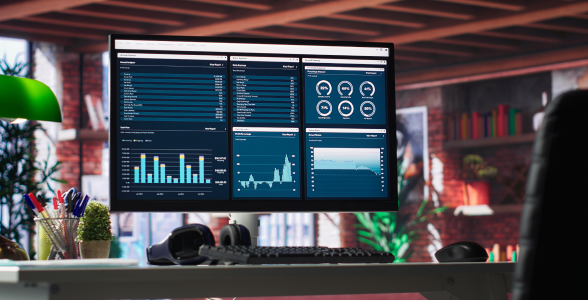
Capture machine telemetry, operational logs, sensor health, and coverage data. Surface it through customizable dashboards and KPI tracking. Identify underperforming machines, predict maintenance needs, and measure autonomous productivity across the fleet.

API Integrations
API Integrations

Connect to OEM enterprise systems, dealer management platforms, and third-party services. John Deere Operations Center integration available. Custom dashboard access via data API.

MESH NETWORKING SOFTWARE

Connectivity without infrastructure.

Mach’s mesh networking software enables machine-to-machine communication without cellular infrastructure. Vehicles communicate directly via mesh radio — so autonomous fleets operate in areas with zero cell coverage. Remote farmland, mine pits, forward operating bases, maritime environments.

The mesh is self-healing: if one node drops, the network reroutes automatically. The same mesh carries the airfield-wide E-Stop signal — one button stops every machine on the network. The mesh can be extended to non-autonomous vehicles, giving fleet-wide situational awareness and emergency control to machines that aren’t even running Mach’s autonomy software.

Mesh Section Image

Why Choose Us

WHY MACH SOFTWARE

Edge-First Architecture

Every safety-critical decision happens on the machine. No cloud latency. No connectivity dependency. The vehicle stops for obstacles whether it has cellular signal or not.

Open Architecture
Open Architecture

Run Mach's neural networks or your own. Integrate via standard protocols. White-label the operator interface. The platform adapts to your product strategy.

Cross-Industry Proven

The same software stack powers orchard sprayers, solar rovers, military ground vehicles, mine clearance robots, and autonomous loaders. 30+ vehicle platforms across 6 industries — no other autonomy supplier matches this breadth.

Functional Safety by Design

ISO 25119 compliant. Three independent safety layers. Hardware watchdog E-Stop. Production-validated across hundreds of deployed machines.

One Operator, Many Machines

Mission Control is designed for the workforce reality. Multi-machine supervision, mesh coordination, and single-button fleet E-Stop.

Continuous Improvement

Every machine gets better over time via OTA. New perception models. Improved algorithms. Bug fixes. Feature additions. All delivered remotely.

Contact Us

Ready to add intelligence to your machines?

Whether you're building your first autonomous prototype or scaling a production fleet, Mach's software platform meets you where you are.

How to Partner with Mach?

Partner with Mach to accelerate your autonomy roadmap. From smart implements to full-stack solutions, we help OEMs go to market faster with scalable, proven tech.

Contact Mach
Seraphinite AcceleratorOptimized by Seraphinite Accelerator
Turns on site high speed to be attractive for people and search engines.