Quad-Core A72
1.5 GHz
IP67
MIL-STD-810
9 DOF IMU
Onboard Inertial
The Problem
Autonomy programs don’t stall at the sensor layer. They stall at the gap between what the machine sees and what it does next. Integrating perception hardware is solvable. Building a reliable, safety-validated control layer that closes the loop from sensor input to machine action — that’s where most programs fail.
Every scenario below has ended a real autonomy program. Command was built to close that gap.
Cameras and radar generate environmental data continuously. Without an intelligent control layer, that data doesn’t translate into machine behavior. It sits in a buffer while the machine waits for instruction.
A machine that can see obstacles but can’t respond correctly is a liability event. Safe autonomous behavior demands deterministic, real-time control logic — not best-effort software running on a shared processor.
Autonomous machines must handle steering, speed, implement state, and safety responses simultaneously — in real time, under changing field conditions — without an operator making judgment calls.
Most failed autonomy integrations don’t fail at the sensor level. They fail because the control architecture between perception output and vehicle action was never engineered for production loads and real-world edge cases.
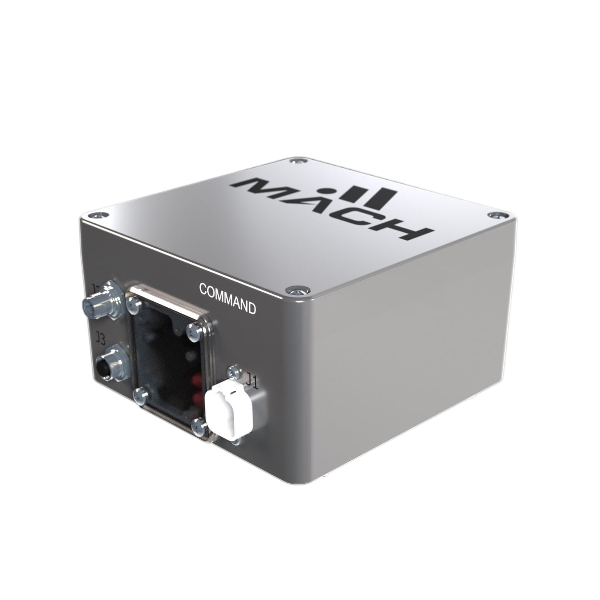
Mach Command is the decision and control layer of the Mach autonomy stack. It receives data from every sensor, processes it in real time across dedicated compute cores, and delivers precise instructions to the vehicle — continuously, without interruption, across changing conditions and real-world hazards.
// Dual-processor architecture: High-performance application processor + dedicated real-time MCU. Your autonomy logic and your safety logic don’t share compute.
View Technical Brief →Continuous vehicle guidance without operator input. Command interprets route plans, sensor feedback, and terrain data to keep machines on task — adapting to changing field conditions in real time throughout the mission.
Real-time route generation and re-planning in response to obstacles, terrain changes, and mission updates. The machine doesn’t stop when conditions change —it adapts and continues executing the job.
Direct command of steering, speed, implement state, and auxiliary systems via CAN bus and high-side drive outputs. Command speaks your machine’s language — wired directly into the vehicle control architecture at factory.
A dedicated 480 MHz real-time Cortex M7 MCU handles safety-critical decisions independently of the main application processor. Safety logic isn’t a software layer — it’s a separate compute domain that cannot be blocked by application load.
Job mapping, in-field path planning, implement automation, and command & control flow through Command’s application processor. Load a mission. Command executes it continuously — managing people, obstacles, and real-time hazards without interruption.
Coordinates operator inputs from Mach Pilot, sensor data from Perception and RadX, fleet communications from Nexus, and mission analytics to Ops — all synchronized through a single control intelligence layer at the center of your platform.
// Full technical specification sheet available on request — no CAPTCHA
Every number below is from the Mach Command specification sheet. Dual-processor architecture. Full sensor fusion. Production-grade ruggedness.
Cortex A72
Quad-core ARM application processor. Compute headroom for sensor fusion, path planning, and mission management running in parallel.
Real-Time MCU
Dedicated Cortex M7 safety processor. Isolated compute domain for safety-critical vehicle control — independent of application layer load.
Ingress Protection
Dust-tight. 30 minutes at 1 m submersion. Vibration-rated for heavy equipment. Wash-down tolerant for agricultural and construction environments.
Operating Range
−20°C to +55°C operating temperature (battery limited). Storage rated −25°C to +60°C. Full seasonal range of field operations.
Microprocessor: Quad-core Cortex A72 at 1.5 GHz for application workloads. Real-time MCU: 480 MHz Cortex M7 for safety-critical and deterministic control tasks. Two independent compute domains in one unit — your autonomy brain and your safety brain don’t compete.
Memory: 4 or 8 GB RAM depending on configuration. Storage: 256 GB SSD for mission logs, maps, and onboard data. Sufficient headroom for full-shift data capture, route maps, and real-time sensor fusion buffers without cloud dependency during operation.
Enclosure sealed to IP67. Designed to meet MIL-STD-810 for shock, vibration, and temperature. Battery backup to ride through voltage transients. Operating temperature: −20°C to +55°C. Storage temperature: −25°C to +60°C. Factory-install ready.
Input power: 9–32 VDC, 1A max. Ethernet: 1000/100/10 Base-T/TX. One CAN bus. Two RS232 (optional). One USB (optional). Two 5A (10A peak) high-side drive outputs for implement and actuator control. Integrates directly with Mach Perception, RadX, Nexus, and Pilot.
9 degrees-of-freedom MEMS inertial measurement unit integrated. Fiber optic gyro available as optional configuration for high-precision heading applications. Enables orientation awareness, slope detection, and dead-reckoning navigation independent of GNSS availability.
Application domains supported: sensor fusion, vehicle navigation, implement automation, in-field path planning, job mapping, command & control. Designed for agricultural, construction, and industrial autonomous platforms operating at production scale
Every product in the Mach platform connects to Command. Perception and RadX feed it sensor data. Nexus carries its instructions across the fleet. Pilot passes it operator inputs. Ops receives its mission telemetry. Command closes the loop between what the machine senses and what the machine does.
Receives stereo vision and obstacle detection data from Mach Perception. Fuses it into real-time path and safety decisions.
Receives phased-array radar detection data. Enables obstacle response in dust, darkness, and through vegetation where cameras cannot operate.
Issues steering, speed, implement state, and auxiliary commands via CAN bus and high-side drive outputs directly to vehicle systems.
Accepts operator inputs, override commands, and E-stop signals from Mach Pilot. Operator retains full supervisory authority at all times.
Mission state and telemetry pass through Mach Nexus to the Mach Ops cloud platform for fleet coordination, logging, and post-mission analysis.
Deploy Command as your control layer with your own perception hardware, or integrate the complete Mach platform for full sensor-to-fleet autonomy.
Mach Command powers autonomous decision-making across every industry where off-highway machines operate. The same architecture. The same production reliability.
Autonomous tractors, harvesters, and sprayers executing precise field operations. Command handles in-field path planning, implement automation, and GPS-Degraded navigation in orchard and row-crop environments.
See Agriculture Integration →Grading, compaction, and earthwork platforms executing precise autonomous passes on active sites. Command coordinates machine position, implement depth, and site boundaries for consistent pass-after-pass performance.
See Construction Integration →Haul truck and equipment autonomy in open-pit and surface mining operations. Command handles route management, hazard response, and multi-machine coordination on high-value haul corridors.
See Mining Integration →Autonomous mowing and ROW management equipment operating on utility corridors. Command coordinates multi-zone coverage paths and implements safe operating boundaries across varied terrain.
See Vegetation Mgmt Integration →Unmanned ground vehicles operating in GPS-Degraded and contested environments. Command provides the control intelligence for autonomous navigation, mission execution, and safe operation where operators cannot follow.
See Defense Integration →Autonomous ground vehicles in industrial facilities, ports, and logistics environments. Command manages structured route execution and safe coordination with human personnel in shared workspaces.
See Industrial Integration →Tell us about your platform, your control requirements, and your autonomy roadmap. A Mach engineer will scope the Command integration path and send you the full technical package.
Building Command into a new or existing OEM platform. Talk to a Mach integration engineer about your vehicle architecture, control requirements, and timeline.
Request Technical Briefing →Technical evaluation of Command for your autonomy program. Review architecture, integration requirements, and compatibility with your existing vehicle control systems.
Schedule Engineering Review →Exploring the full Mach platform — Perception, RadX, Command, Nexus, Pilot, and Ops — as an integrated autonomy stack for your OEM program.
Explore The Platform →