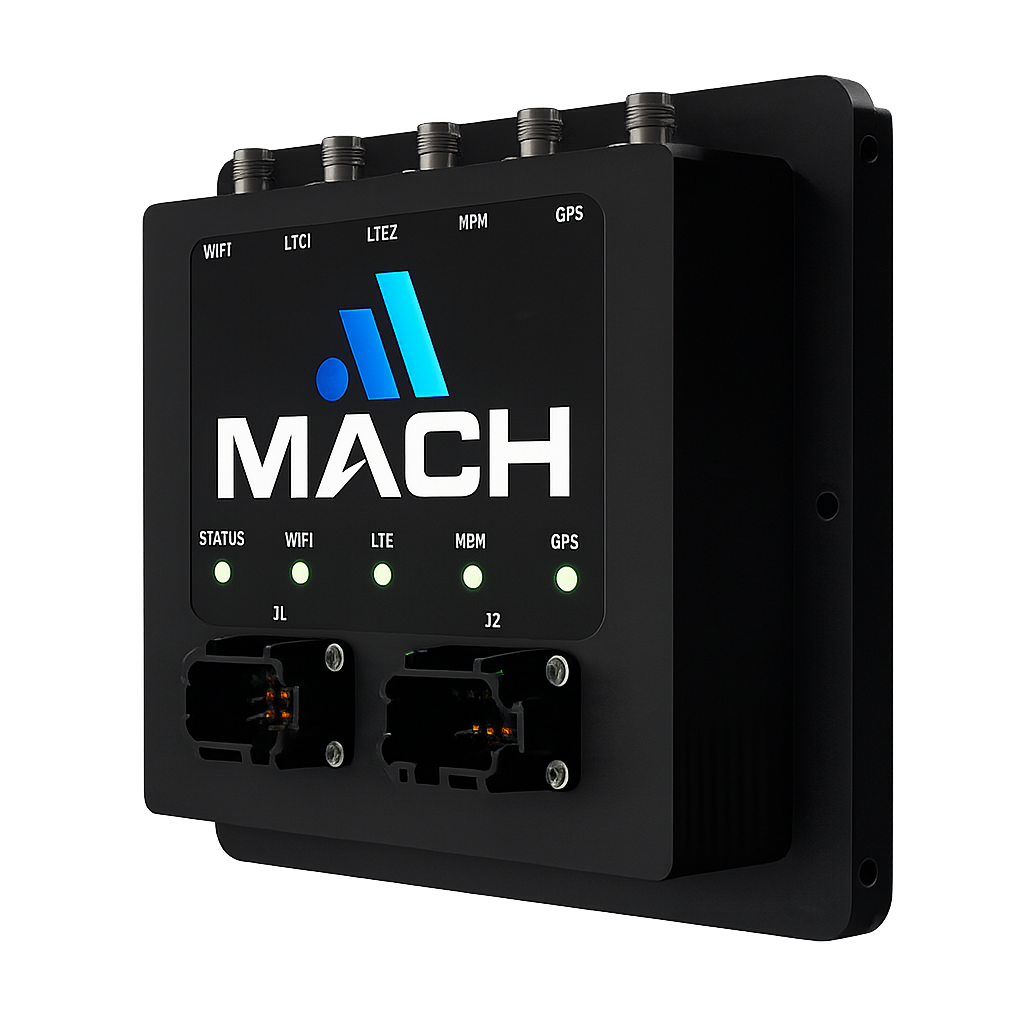
Three Radios
LTE · Wi-Fi · Sub-GHz
IP67
MIL-STD-810 Rated
OTA Ready
Cloud Fleet Management
Off-highway fleets without reliable connectivity lose fleet visibility, fall behind on software, and create maintenance blind spots. When machines can't communicate, operational intelligence stalls — and so does your autonomy program.
Every unplanned machine failure costs field hours. Every missed OTA update is a liability gap. Every fleet running without visibility is a maintenance and safety program running blind.
Machines in isolation give operators no position, status, or system health data. You can't manage what you can't see.
Software patches and safety updates can't reach disconnected machines. Every update requires a physical service trip to every unit.
Without real-time diagnostics, failures are discovered in the field — not before deployment. Unplanned downtime costs hours and customer trust.
Vehicles, implements, operators, and cloud platforms that can't communicate can't function as a unified fleet. Autonomy at machine level doesn't scale without connectivity infrastructure.
Nexus integrates LTE, Wi-Fi 5, sub-GHz M2M mesh, and GNSS into a single MIL-STD-810 rated gateway. The connectivity infrastructure that lets autonomous machines operate as a coordinated, visible fleet — online or offline, at any scale.
// Three simultaneous radios: LTE, sub-GHz M2M, and Wi-Fi 5 operate independently and simultaneously. Fleet connectivity doesn't fail when one channel drops.
Real-time position, telemetry, and system status across every machine in your fleet. GNSS tracking and health monitoring from a single cloud management platform — with or without cellular via M2M mesh.
Push firmware, configuration changes, and safety patches to every machine without physical access. Nexus manages the secure update pipeline so your machines stay current between deployments
Sub-GHz mesh radio enables vehicle-to-vehicle coordination beyond cellular range. Fleet synchronization and collision avoidance data keep operations running when the cloud isn't reachable.
Nexus feeds machine data, position, and status into Mach Ops for fleet-level analytics and logistics coordination. Raw machine data becomes actionable operational intelligence at fleet scale.
Three simultaneous radios. IP67 sealed. MIL-STD-810 rated. Built for continuous factory-installed operation where commercial hardware fails.
Simultaneous Channels
LTE, sub-GHz M2M, and Wi-Fi 5 operate simultaneously. Fleet connectivity doesn't fail when one channel drops.
Ingress Protection
Dust-tight. Submersion rated. Vibration-qualified for heavy equipment. Engineered for the machine, not the test bench.
Operating Temp Floor
Full range −40°C to +70°C operating, −40°C to +85°C storage. Survives the complete thermal envelope of off-highway equipment.
Onboard Storage
4GB eMMC Flash with 512MB DDR3 RAM. Local buffering keeps telemetry intact through connectivity gaps.
Primary cloud connectivity. Maintains telemetry, OTA delivery, and remote monitoring in areas with partial cellular coverage — LTE connectivity with fallback where supported by the modem and local network.
Machine-to-machine peer networking via sub-GHz radio. Vehicles form a self-organizing mesh independent of cellular infrastructure — fleet coordination and collision avoidance data sharing offline.
Application processor paired with a dedicated real-time MCU. Connectivity management and machine control run on separate cores. 512MB DDR3 RAM and 4GB eMMC Flash.
Dual CAN bus. Separate uplink/downlink Ethernet (10/100Base-TX) plus 100/1000Base-T1. Three analog inputs. 9–32VDC input with integrated 2A motor driver output.
Nexus links every layer of the MACH autonomy stack — and integrates directly into your existing machine architecture. CAN bus, dual Ethernet, and wide-voltage input mean your engineering team works with familiar interfaces.
Feeds real-time telemetry and position into cloud fleet management. Provides cellular and M2M connectivity for autonomous path execution and remote configuration.
LTE, sub-GHz M2M, and Wi-Fi 5 operate independently. Redundant connectivity without manual fallback configuration.
Relays sensor event data and diagnostic logs from Mach Perception and RadX via CAN bus for remote fleet analytics and post-mission review.
9–32VDC covers 12V and 24V machine electrical systems. Integrated motor driver output for implement control without external power conversion.
Built for the connectivity challenges specific to off-highway autonomy — mixed cellular coverage, machines operating in groups, software that must reach the field without a service vehicle.
OTA updates, GNSS tracking, and M2M coordination for autonomous sprayers and field groups across large areas with mixed cellular coverage.
See Agriculture Integration →Real-time equipment status, remote diagnostics, and coordinated machine awareness across active construction sites where cellular coverage is partial.
See Construction Integration →Sub-GHz mesh networking for vehicle coordination and remote monitoring on haul routes with limited infrastructure — no full cellular dependency required.
See Mining Integration →Centralized fleet visibility, OTA software management, and machine-to-machine coordination for scalable autonomous fleet operations across industrial sites.
See Industrial Integration →Tell us about your platform, your operating environment, and your connectivity requirements. A Mach engineer will scope the Nexus integration and send you the full spec sheet.
Talk to a Mach engineer about Nexus connectivity architecture, CAN/Ethernet I/O, and OTA fleet management for your platform.
Evaluating connectivity infrastructure for an autonomous fleet program? Let's scope the Nexus integration for your use case.
See how Perception, RadX, Command, Pilot, and Ops work together as a unified OEM integration platform.
View Full Platform →