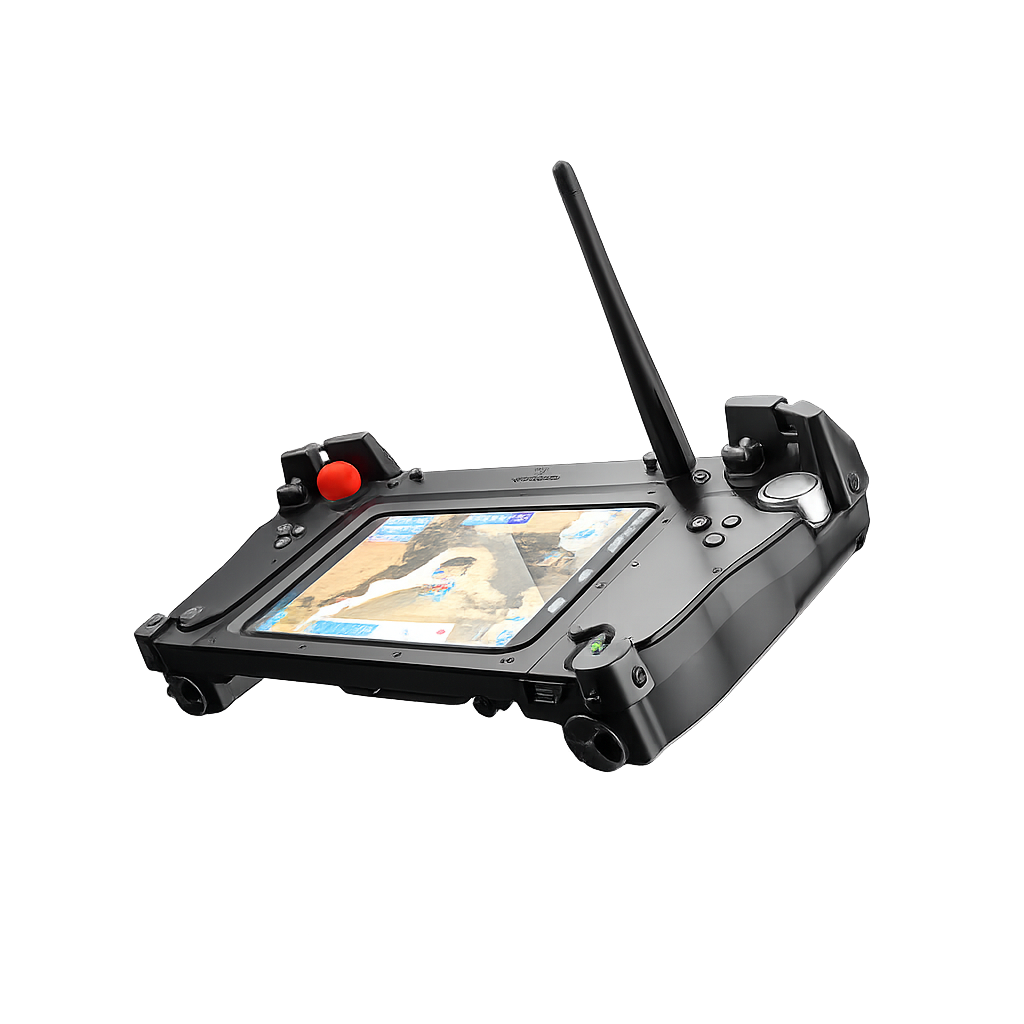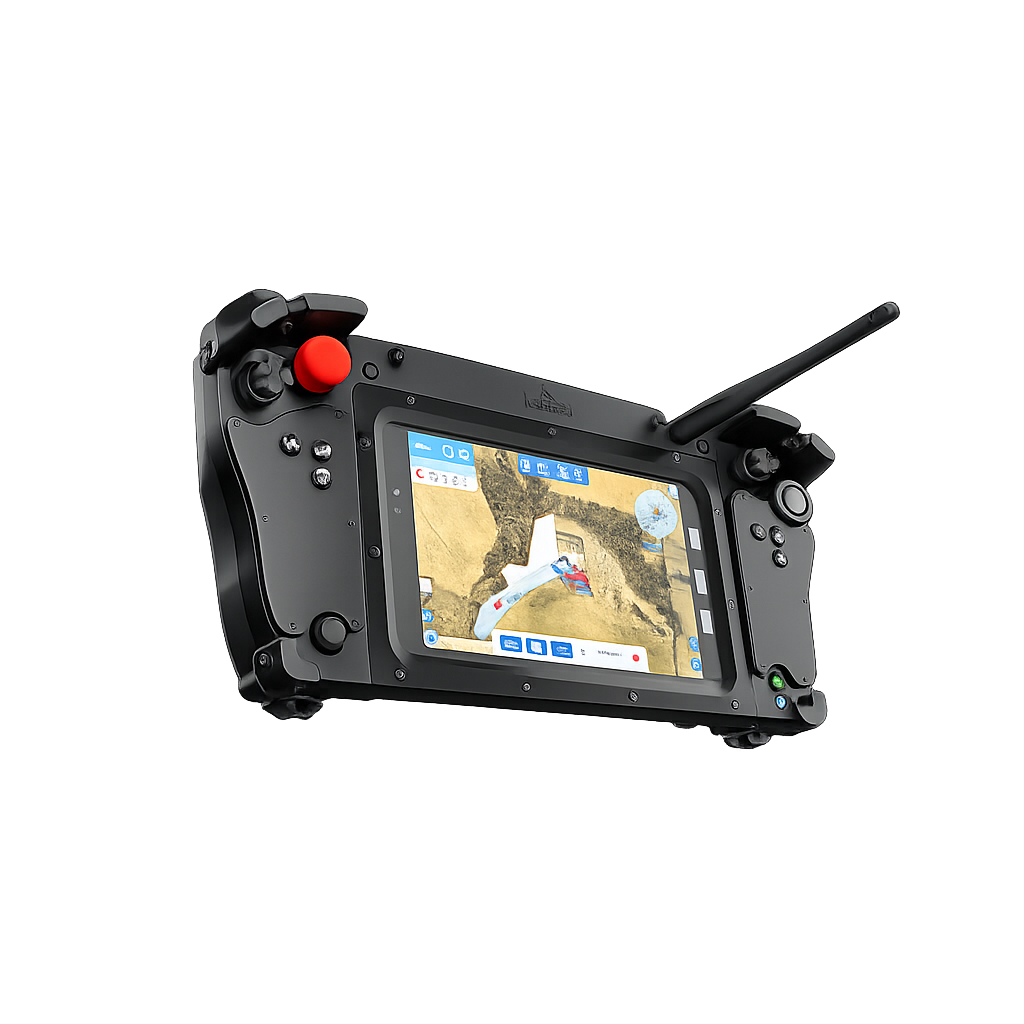
Multi-Machine
Control & E-Stop
IP67
MIL-STD-810
Hot-Swap
Li-Ion Batteries
Autonomous doesn't mean unsupervised. Operators need to intervene, override, test, calibrate, and stop machines — from wherever they are on site. Without a capable handheld interface, human oversight breaks down exactly when it's needed most.
Control authority matters at fleet scale. As the number of autonomous machines grows, so does the need for simple, reliable, operator-held control. A single E-Stop moment across a 10-machine fleet requires hardware that works — every time, in every condition.
Operators need remote control and override capability outside the cab — during field operations, setup, testing, and emergency scenarios. A tablet on a mount doesn't cover that.
Managing multiple autonomous assets simultaneously requires seamless toggling between machines and a single E-Stop that reaches the entire fleet — without switching devices or interfaces
E-Stop authority needs to be hardware-level, fast, and always accessible regardless of software state. Touchscreen-only interfaces can't guarantee safety-critical response times in the field.
Consumer tablets and off-the-shelf controllers fail in dust, rain, drops, and temperature extremes. Field testing and calibration requires hardware designed for the environment — not adapted to it.
Pilot gives operators total remote control authority in a single rugged handheld. Configurable controls adapt to any machine or application. Multi-machine control and simultaneous E-Stop keep operators in command across the entire site.
// Tablet-based GUI: Works with Samsung Tab Active5. Embedded Linux OS. Tablet-based graphical interface provides flexibility to design specifically for your brand and machines.
Seamlessly toggle between multiple autonomous assets from a single Pilot unit. Manage vehicles, implement control, and operational states across your entire deployed fleet from one handheld interface.
Dedicated hardware E-Stop switch provides direct emergency-stop control. A simultaneous E-Stop command can be distributed across the mesh network to connected machines through a single operator action.
Two-axis joysticks and configurable switches give operators direct manual override authority at any point during autonomous operation. Take control of any machine immediately when conditions require human judgment.
Direct vehicle and implement control through configurable joysticks, switches, and scroll wheel. Pilot's tablet-based GUI provides real-time machine state and operational visibility while controls are in the operator's hands.
Pilot provides the mobile interface for field testing and system calibration. Take the interface to the machine — no fixed workstation needed. IMU-based drop detection adds a safety layer for testing in live operational environments.
The tablet-based graphical user interface is designed for OEM customization. Configure the layout specifically for your brand and machines. Optional customizable button plates extend hardware-level control to match your application requirements
Every control surface, every material choice, and every structural element is engineered for continuous field use — not adapted from consumer hardware.
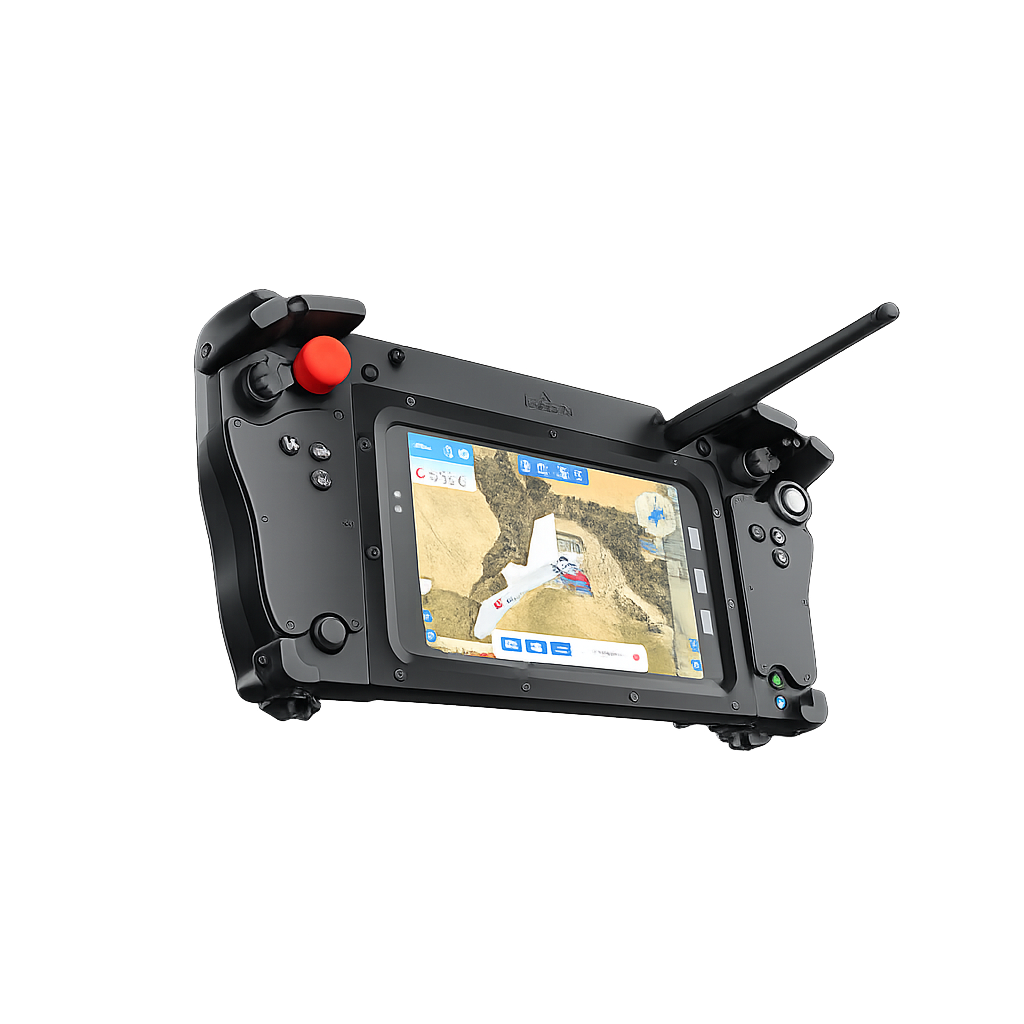
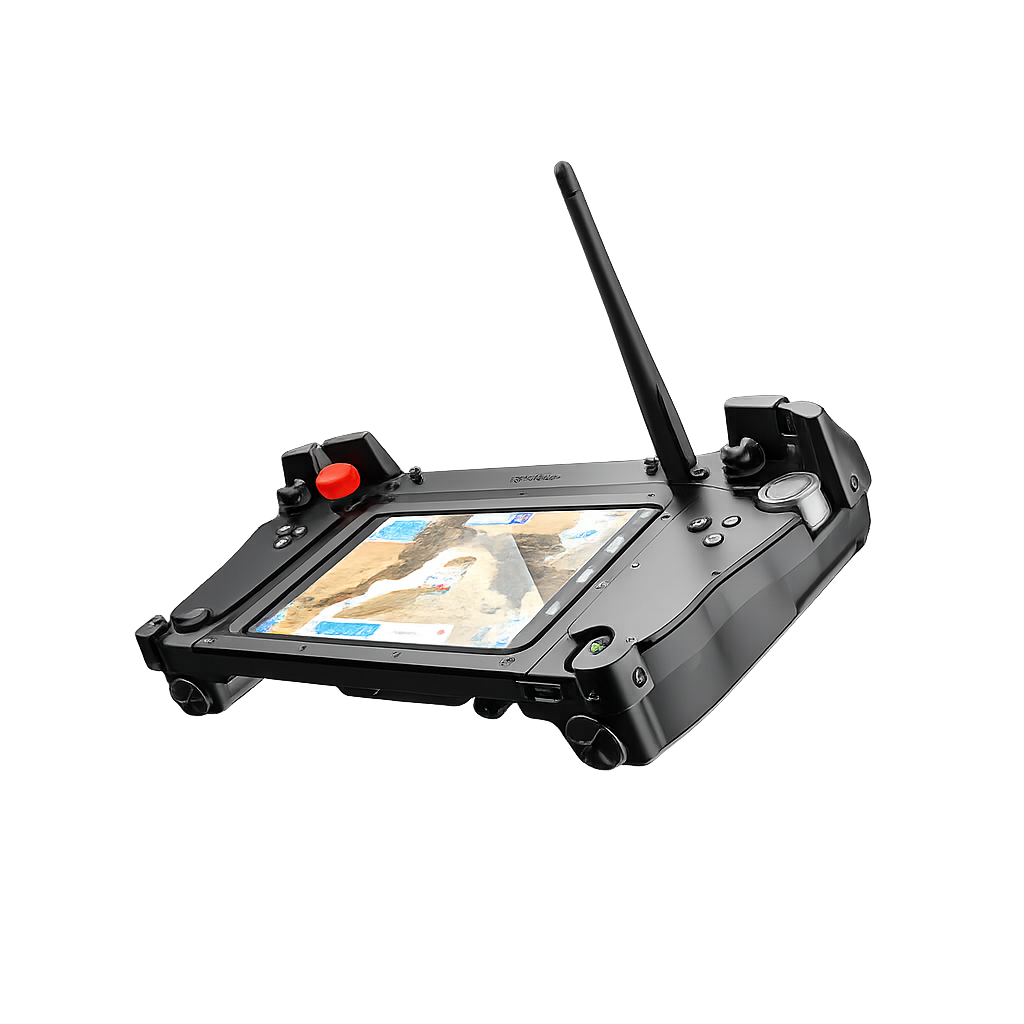
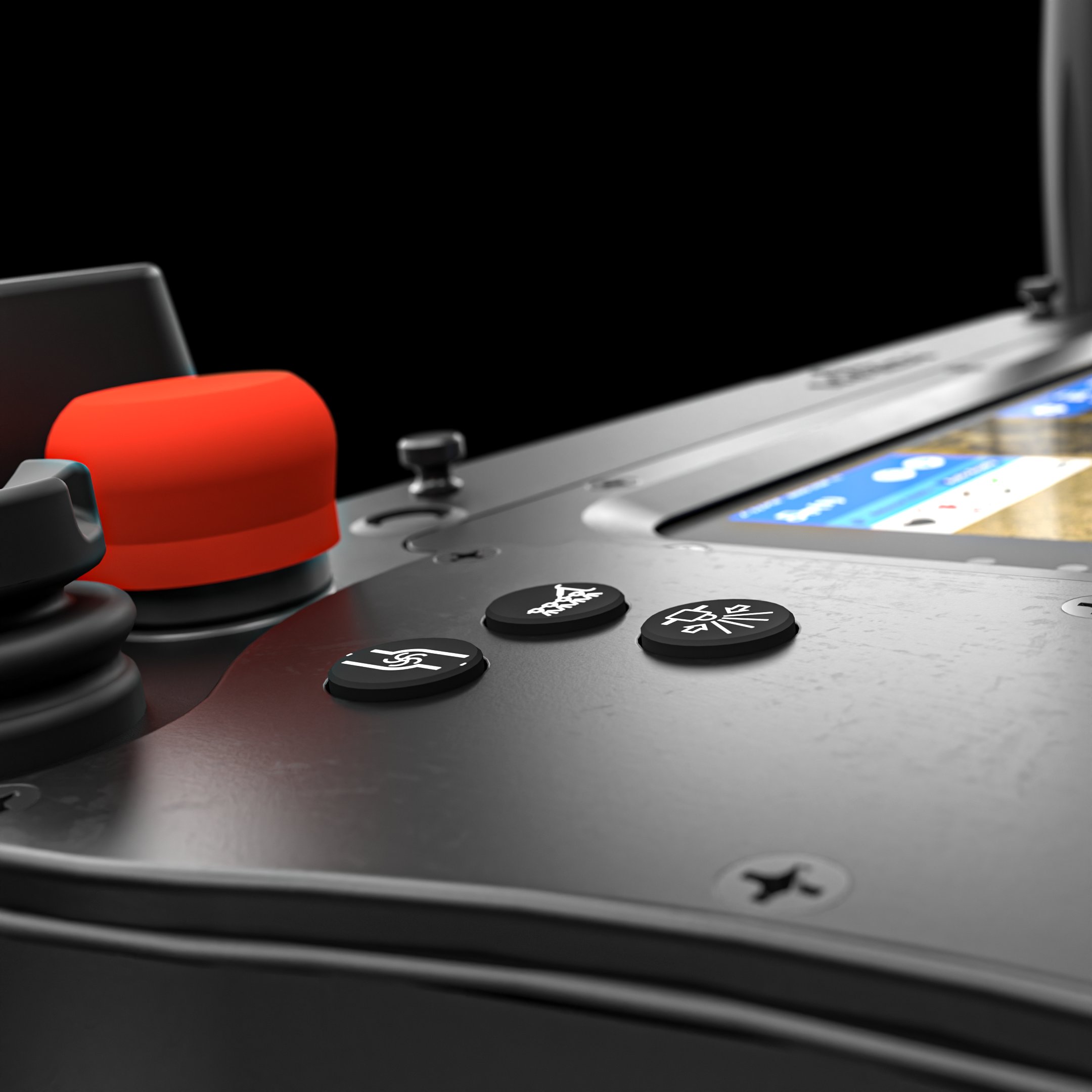
Dedicated hardware emergency stop switch provides direct machine-stop authority. Designed for safety-critical situations without relying solely on software control.
Left and right five-button switches with optional custom button plates. OEMs can configure control layouts to match their specific machine functions and operator workflows.
Left and right two-axis joysticks plus front single-axis joysticks and right-side scroll wheel. Haptic vibration feedback confirms control inputs in loud, high-vibration field environments.
Protective bumper guards shield joysticks and switches from impact damage. Drop-tested to survive field handling. IMU detects drops and triggers safety protocols automatically.
IP67 sealed. MIL-STD-810 rated. Drop-tested. Hot-swappable power. Built for the complete operational envelope of off-highway autonomous equipment.
Sealed Enclosure
Dust-tight and submersion rated. Protective bumpers shield controls from impact. Drop-tested to survive real field handling.
Durability Standard
Designed to meet MIL-STD-810 durability standards. Temperature, vibration, and shock-qualified for continuous off-highway deployment.
Hot-Swap Li-Ion
Dual hot-swappable Li-Ion batteries ensure uninterrupted power during operation. Swap one battery without stopping the mission.
Mesh Wireless Link
Sub-GHz wireless link to vehicle Nexus gateway. Mesh network connectivity for multi-machine control and simultaneous E-Stop across the fleet.
Tablet-based graphical user interface running on the Samsung Tab Active5. Provides a flexible operator interface for machine-specific controls, system status, and real-time operational visibility. Dedicated controller firmware manages the machine control functions, with the tablet providing the operator interface.
Connects wirelessly to the vehicle Nexus gateway via sub-GHz radio. Mesh network architecture enables multi-machine control and simultaneous E-Stop across all connected assets. Wired USB-C for power and charging.
Left and right two-axis joysticks. Left and right five-button switches. Right-side scroll wheel. Left and right front single-axis joysticks. Haptic vibration feedback. Optional customizable button plates for OEM-specific control layouts.
Dedicated E-Stop switch for operator safety. IMU for drop detection — automatically triggers safety protocols if the device is dropped in the field. Protective bumpers shield joysticks and switches from impact damage
Pilot is the human layer of the MACH autonomy stack. It connects directly to Nexus on every machine, giving operators real-time control authority across the fleet while the autonomy platform handles path planning, obstacle avoidance, and fleet coordination.
Sub-GHz wireless link connects Pilot directly to the Nexus gateway on each machine. Nexus relays commands, status data, and mesh E-Stop signals across the connected fleet.
Seamlessly toggle between machines and trigger simultaneous E-Stop across the mesh network without switching devices or losing operational awareness.
Pilot operates alongside Mach Command for path planning and Mach Ops for fleet visibility. Operators see machine status from Ops in the tablet GUI while maintaining physical control authority through Pilot's hardware interface.
Customizable button plates and OEM-branded tablet GUI adapt Pilot to your specific machine and operator workflow. Factory-ready for integration into your product line alongside the full MACH autonomy stack.
Tell us about your machine platform, operating environment, and operator workflow requirements. A Mach engineer will walk you through Pilot and the full MACH control integration path.
See Pilot in action with your machine type. Walk through multi-machine control, E-Stop, and the OEM customization process with a Mach engineer.
Get the complete Pilot spec sheet including configurable control layouts, rugged certifications, wireless link details, and OEM integration notes.
See how Pilot works alongside Nexus, Command, Perception, RadX, and Ops as a unified OEM autonomy integration platform.
View Full Platform →